
Terrazzo
Tiles are manufactured in the UK in the following sizes:
- > 597x597x42 mm
- > 500x500x40 mm
- > 497x497x38 mm
- > 400x400x40mm
- > 397x397x33 mm
- > 300x300x28 mm
- > 297.5x297.5x28mm
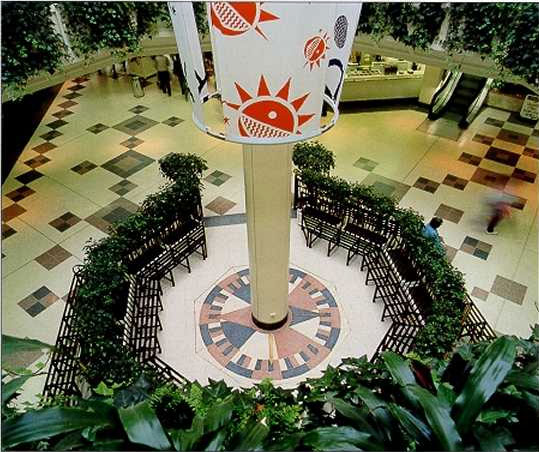
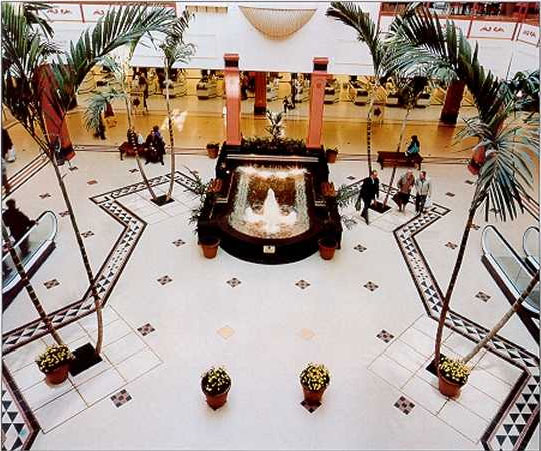
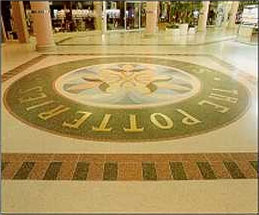
Can also be supplied rectangular and with a textured finish. Tiles can be final polished or finished on site after laying and grouting, which is the norm. They are delivered shrink wrapped and on pallets and especially manufactured to the swatch chosen or to the clients aggregate and matrix choice. A sample being made for final approval. Bedding direct to concrete saves the need to screed, being laid monolithic and any reinforcing requirement is incorporated within the bedding. Click to view swatches.
Pre-cast Terrazzo
Treads, risers, skirting and strings can be manufactured to any size and design and section, incorporating a variety of anti-slip inlays and finished well edgings. Pre-cast posts and partitions can also be manufactured all to measured site requirement. See sections.
In-situ Terrazzo
This can be laid to floors, walls, treads , risers , skirting and strings, screed and formwork being undertaken by the terrazzo layer. Any section can be achieved and anti-slip inlay incorporated as with the pre-cast. Cementicious and resin based matrix is available.


Terrazzo History
 Terrazzo is an extremely versatile material which can be applied insitu to floors and other surfaces, made into tiles or cast into moulds to almost any shape. It is probably the most widely used of all hard floorings, certainly in heavily trafficked areas. It is to be found in shopping malls, airports, railway and underground stations, hospitals and supermarkets.
The name "terrazzo" derives from the Italian word "terrazza" meaning terrace. It is so called because this type of flooring originated in the north eastern region of Italy known as Friuli, where the inhabitants hundreds of years ago utilised pebbles and stones from nearby river beds to pave the earth adjacent to their homes. The surface thus produced was naturally uneven and over time a method was devised for rubbing down the floors. This consisted of a long wooden pole to one end of which was fixed a rough stone weighted to produce the necessary abrasion.
One of the earliest printed references to the craft is in a book printed in Venice in 1581 and the technique was also mentioned by the architect Palladio in his published works in 1738. Many of the Palladian country houses and villas in the areas around Venice and Vicenza had floors laid by Friuli craftsmen. These show refinements in technique gradually taking place in this period. Wooden templates were employed to separate colours and to create floral and other designs; aggregates were mixed and graded; lime was incorporated into the matrix and marble dust was introduced as a colouring agent.
Practitioners became more in demand and in the 18th and 19th centuries the "terrazzieri", as they were known, began emigrating throughout Europe and all over the world. This process continued with fluctuations up to the second world war. Until about this time the trade remained almost exclusively in Italian hands and was mainly a laborious manual business, though single head grinding machines, new polishing materials and dividing strips in plastic, brass and aluminium appeared in the 1920's and 1930's and caused some changes in methods.
After the war machinery became more complex. With the advent of multi-station automatic presses and multi-headed linear grinders for making terrazzo tiles, a real transformation occurred, accelerated by the increasing demand for speedier operations on building sites. This was also responsible for the demand for terrazzo in prefabricated form, whereby the finishing was done in the workshop to save installation time. A few members of the NFTMMS are engaged solely in manufacturing items such as staircases, skirtings, slabs, column facings and many other items for commercial and domestic application.
Click to view the Terrazzo swatches - you can click on each thumbnail image to view in closer detail.
Go to the Members' Links in order to locate your nearest Terrazzo Specialist.
Inspection Services
National Federation of Terrazzo Marble & Mosaic Specialists